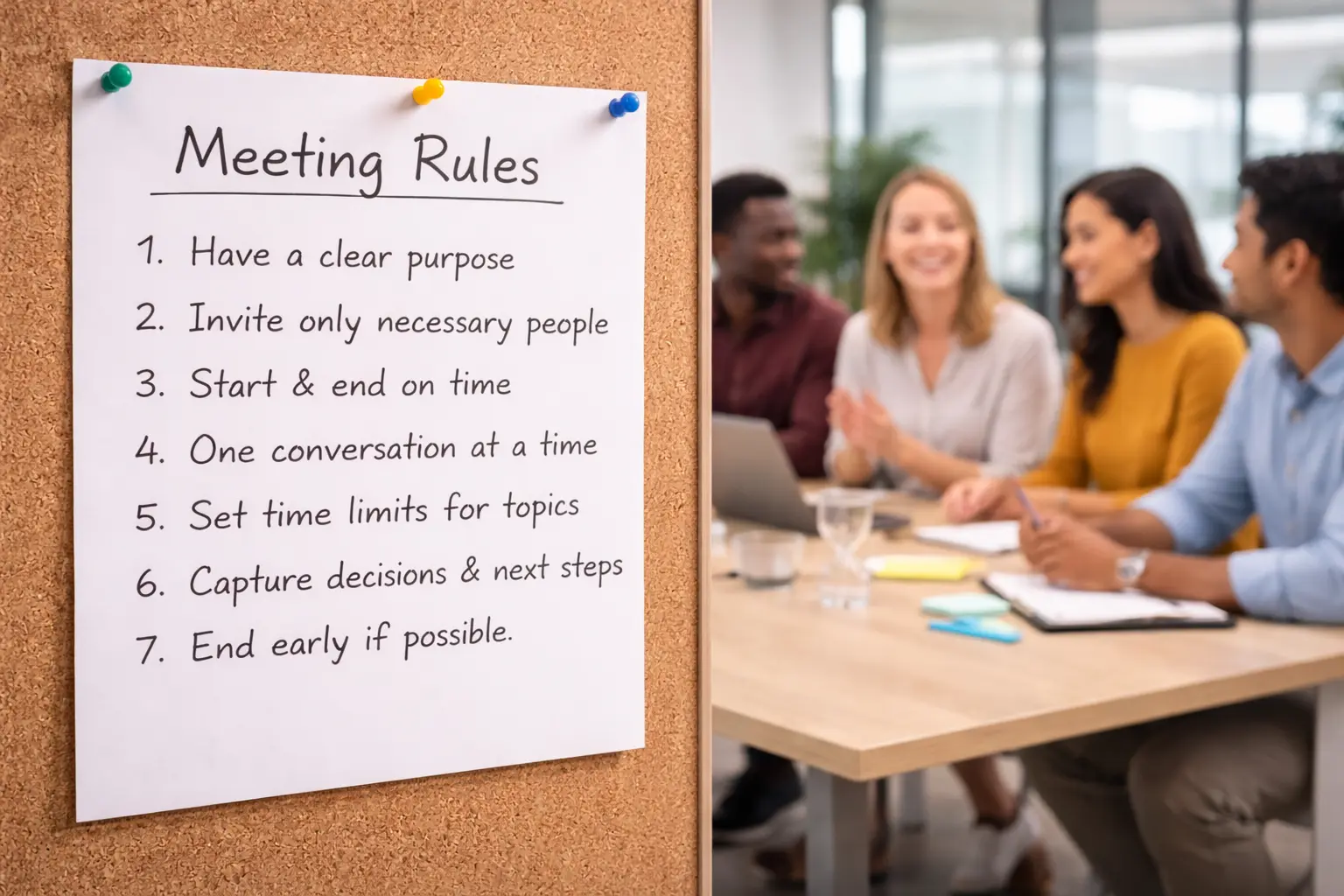
How to Combat Meeting Fatigue
You finish your last meeting of the day, close your laptop, and realize you're completely drained — even though you barely left your chair. Your to-do list is untouched, your brain feels foggy, and the thought of one more conversation makes you want to disappear. This feeling has a name: meeting fatigue.
Meeting fatigue is not laziness or a lack of discipline. It is a genuine cognitive and emotional response to spending too much time in structured conversations, especially when those conversations happen back to back with no recovery time. Understanding what causes it — and what you can do about it — is the first step toward reclaiming your energy and focus at work.

What Is Meeting Fatigue?
Meeting fatigue describes the mental and physical exhaustion that builds up after attending too many meetings, particularly in a short period of time. It goes beyond simple boredom. People experiencing meeting fatigue often report difficulty concentrating, reduced motivation, irritability, and a sense of being overwhelmed — even when the meetings themselves are not inherently stressful.
The term gained widespread attention during the shift to remote work, when video calls became the default mode of communication. Researchers at Stanford and Microsoft both published studies showing that virtual meetings place a unique cognitive burden on participants, leading to faster and deeper exhaustion compared to in-person conversations.
But meeting fatigue is not limited to video calls. Anyone who has sat through a full day of in-person meetings knows the same drained feeling. The underlying problem is the same: too many meetings, too little space between them, and too few opportunities for the kind of deep work that actually moves projects forward.
Why Meetings Are So Draining
To understand why meetings tire us out so quickly, it helps to look at what your brain is doing during a typical meeting. You are constantly processing multiple streams of information at once — listening to the speaker, reading body language, formulating your own responses, and monitoring social dynamics. This level of sustained attention is cognitively expensive.
Video calls amplify this cost significantly. On a video call, your brain works harder to interpret facial expressions and vocal tone because the usual contextual cues are flattened or delayed. You are also hyper-aware of your own appearance in the self-view window, which creates an additional layer of self-monitoring that does not exist in face-to-face conversations.
Back-to-back scheduling makes things worse. When one meeting ends and another begins immediately, there is no time for your brain to process what just happened, switch context, or simply rest. Research from Microsoft's Human Factors Lab found that consecutive meetings without breaks cause stress levels to build progressively, with beta wave activity in the brain — associated with stress — increasing steadily over time.
Other common factors that contribute to meeting fatigue include:
- Meetings that lack a clear purpose or agenda
- Being included in meetings where your presence is not essential
- Meetings that could have been an email or a quick message
- Large meetings where most participants are passive listeners
- Poor facilitation that allows discussions to wander
- The pressure to appear engaged and attentive at all times
The Hidden Cost of Too Many Meetings
Meeting fatigue does not just make people tired. It has measurable effects on productivity, creativity, and wellbeing. When people spend the majority of their workday in meetings, they lose the uninterrupted time needed for deep thinking, problem solving, and creative work.
A study published in the MIT Sloan Management Review found that when companies reduced meetings by 40%, employee productivity increased by 71%. Satisfaction also rose significantly, and stress levels dropped. These numbers are striking, but they make sense when you consider that most knowledge workers do their best work during quiet, focused periods — not during group discussions.
Beyond individual productivity, meeting fatigue erodes team morale over time. People start to resent meetings rather than value them. They disengage, multitask, or mentally check out. Decisions suffer because the people in the room are too exhausted to think critically. Ironically, the more meetings a team holds to stay aligned, the less aligned they often become.
Keep Meetings Short and Focused
One of the most effective ways to combat meeting fatigue is to shorten your meetings. The default 30- or 60-minute meeting slot is an artifact of calendar software, not a reflection of how long discussions actually need to be.
Challenge the assumption that every meeting needs a full half hour. Many discussions can be wrapped up in 15 or 20 minutes when there is a clear agenda and a facilitator keeping things on track. Shortening meetings by even five minutes creates breathing room that adds up significantly over the course of a day.
Some teams adopt the practice of scheduling meetings for 25 or 50 minutes instead of 30 or 60. This simple change guarantees a buffer between sessions, giving people time to stand up, stretch, grab water, or simply let their minds reset before the next conversation.

Build Breaks Between Meetings
If shortening meetings is not always possible, building intentional breaks into your schedule is equally important. Even a five-minute gap between meetings can make a noticeable difference in how you feel by the end of the day.
During these breaks, step away from your screen. The temptation to quickly check email or Slack during a short gap is strong, but it defeats the purpose. Your brain needs actual downtime — not just a different kind of input. Look out a window, stretch, walk to the kitchen, or simply close your eyes for a moment.
Many calendar tools now offer settings to automatically shorten meetings or add buffer time. If your organization supports it, enabling these features team-wide can normalize the practice and make it easier for everyone to protect their transition time.
Replace Meetings With Asynchronous Communication
Not every conversation needs to happen in real time. One of the most powerful strategies for reducing meeting fatigue is to identify which meetings can be replaced with asynchronous alternatives.
Status updates, for example, rarely need a live meeting. A brief written update posted in a shared channel or document can convey the same information without pulling five or ten people into a room for 30 minutes. Similarly, decisions that require input from multiple people can often be handled through structured written proposals with comment threads.
Asynchronous communication also has the advantage of giving people time to think before responding. In a live meeting, the pressure to respond immediately can lead to less thoughtful contributions. When people can read, reflect, and respond on their own schedule, the quality of input often improves.
A practical approach is to audit your recurring meetings once a month and ask a simple question for each one: does this need to be a live conversation, or could it be handled asynchronously? You might be surprised how many meetings survive purely out of habit.
Adopt Camera-Off Policies for Some Meetings
Video calls are more fatiguing than audio-only calls. The constant visual processing, the self-view distraction, and the pressure to maintain eye contact all contribute to faster exhaustion. Allowing participants to turn off their cameras for certain types of meetings can meaningfully reduce the cognitive load.
This does not mean cameras should always be off. For team bonding, one-on-one conversations, and sensitive discussions, seeing each other's faces adds genuine value. But for routine check-ins, large presentations, or informational meetings, camera-off policies give people permission to listen without the performance pressure of being watched.
If your team is hesitant to adopt camera-off norms, start small. Designate specific meeting types where cameras are optional, and observe how it affects participation and energy levels. Most teams find that engagement actually improves when people are less focused on appearing engaged.
Try Walking Meetings
Walking meetings are one of the simplest and most underused strategies for combating meeting fatigue. Instead of sitting in a conference room or at your desk for a one-on-one conversation, take it outside and walk.
Movement increases blood flow to the brain, improves mood, and stimulates creative thinking. A study from Stanford University found that walking boosted creative output by an average of 60% compared to sitting. The informal nature of walking side by side also tends to make conversations more relaxed and open.
Walking meetings work best for discussions that involve two or three people, do not require screen sharing, and benefit from a more exploratory or brainstorming approach. They are particularly effective for one-on-one check-ins, mentoring conversations, and problem-solving sessions where fresh thinking is needed.
Protect Focus Time on Your Calendar
If your calendar is open and unblocked, people will fill it with meetings. One of the most effective defenses against meeting fatigue is to proactively block time for focused, uninterrupted work.
Treat these focus blocks with the same respect you would give a meeting with your most important stakeholder. They are not optional padding — they are essential time for the work that actually requires your full attention.
Some organizations have adopted "no-meeting days" — entire days of the week where meetings are discouraged or prohibited. Companies like Shopify and Asana have experimented with this approach and reported positive results in both productivity and employee satisfaction. Even if your company has not adopted this policy, you can advocate for it within your team or simply start by protecting one morning or afternoon per week.
Reduce Meeting Size and Frequency
Large meetings are almost always less productive than small ones. The more people in a meeting, the less each person contributes, and the harder it becomes to reach decisions. Amazon's "two-pizza rule" — if the group cannot be fed with two pizzas, it's too large — is a useful heuristic.
Similarly, question the frequency of recurring meetings. A weekly meeting that was useful six months ago may no longer serve its original purpose. Teams evolve, projects shift, and communication patterns change. Regularly reviewing and pruning your recurring meetings prevents calendar bloat and ensures that the meetings you keep are genuinely valuable.
Before scheduling any new meeting, ask yourself three questions: What is the specific outcome I need from this meeting? Who absolutely needs to be there? Is there a faster way to achieve this outcome without a meeting? If you cannot answer the first question clearly, the meeting probably should not happen.
Use a Timer to Stay on Track
One reason meetings feel so draining is the uncertainty of when they will actually end. A meeting scheduled for 30 minutes that stretches to 45 does not just waste 15 extra minutes — it disrupts the mental model everyone had for their day.
Using a visible timer during meetings creates shared awareness of how much time remains. It encourages concise communication, discourages tangents, and helps the group honor the planned end time. When people trust that meetings will end when they are supposed to, they approach them with more energy and less dread.
A timer also serves as a neutral facilitator. Instead of one person having to interrupt and say "we need to wrap up," the timer provides an objective signal that everyone can see. This removes social awkwardness and distributes the responsibility for time management across the group.