The Hidden Cost of Meetings That Run Over
It seems harmless enough. The meeting was supposed to end at 2:00, but the conversation is still going at 2:12. Someone says "just five more minutes" and nobody objects. By 2:18, people start quietly dropping off or glancing at their next calendar invite with a sinking feeling. What felt like a minor overrun has just set off a chain reaction that will ripple through the rest of the day.
Meetings that run over time are one of the most normalized forms of workplace waste. Because each individual overrun seems small, the cumulative damage rarely gets measured. But when you add up the direct time cost, the context-switching penalty, the cascade effect on other meetings, and the slow erosion of trust, the true price becomes staggering.

The Direct Time Cost
Start with the simplest calculation. If a meeting with eight participants runs ten minutes over, that is not ten minutes lost. It is eighty person-minutes, or one hour and twenty minutes of collective time. If this happens once a day across a team, you are looking at roughly six and a half hours of unplanned time consumption per week from a single recurring meeting.
Scale this across an organization. A company of 200 people where the average employee attends three meetings per day, and one of those runs ten minutes over, loses approximately 1,000 person-hours per week to overruns alone. That is the equivalent of 25 full-time employees doing nothing but sitting in meetings that should have already ended.
These numbers may sound dramatic, but they are conservative. Research from the Harvard Business Review found that 71 percent of senior managers consider meetings unproductive and inefficient, and time overruns are a significant contributor to that perception. The direct time cost is only the beginning.
The Context-Switching Tax
When a meeting runs over, it does not just consume the extra minutes. It destroys the productive time on either side. Cognitive research has consistently shown that switching between tasks carries a significant mental cost. A study by Gloria Mark at the University of California found that it takes an average of 23 minutes to fully refocus after an interruption. A meeting that runs ten minutes late does not cost you ten minutes of deep work. It costs you the ten minutes plus the 20 to 25 minutes of recovery time needed to get back into a focused state.
This is especially damaging for knowledge workers who depend on uninterrupted blocks of time to do their best work. Programmers, writers, designers, analysts, and strategists all need sustained concentration to produce quality output. When a meeting overrun eats into their focus block, the remaining time before the next commitment often feels too short to start anything meaningful. So that time gets spent on shallow tasks like checking email or scrolling through messages, work that feels productive but rarely moves important projects forward.
The context-switching tax is invisible in most organizations because it does not show up on any dashboard or report. But it is one of the largest drains on individual and team productivity, and meeting overruns are one of its primary triggers.
Impact on Subsequent Meetings
Meetings do not exist in isolation. They sit in a chain of calendar events, and when one runs over, the effects cascade. A participant who joins their next meeting five minutes late misses the opening context. The facilitator of that meeting has to either repeat information or proceed without full attendance, neither of which is ideal.
In many organizations, the cascade effect creates a culture of chronic lateness. When meetings routinely start late because people are coming from other meetings that ran over, the schedule starts to slip systematically. A 2:00 meeting that should start at 2:00 actually starts at 2:07, which means it runs until 2:37 instead of 2:30, which means the 2:30 meeting also starts late. By the end of the day, the entire calendar has drifted, and everyone feels like they spent the day running behind.
This cascade is particularly destructive for people who attend many meetings, such as managers and cross-functional team leads. Their entire day becomes a sequence of meetings that start late, run over, and leave no breathing room. The result is that the people who most need time to think strategically are the ones least likely to get it.
The Trust Deficit
When a meeting organizer consistently lets meetings run over, they are sending an unspoken message: my agenda is more important than your time. Over weeks and months, this erodes trust. Team members start to feel that their boundaries are not respected, that their time is not valued, and that the person running the meeting prioritizes their own need to finish the discussion over everyone else's commitments.
This trust deficit manifests in subtle but corrosive ways. People start mentally checking out before meetings end because they assume it will run over anyway. They stop preparing thoroughly because they expect the meeting to go off track. They begin declining optional meetings preemptively, even useful ones, because they cannot afford the unpredictable time cost.
Leaders are especially vulnerable to creating this dynamic. When a senior leader holds a meeting that regularly overruns, few people feel comfortable pushing back. The power imbalance means that the burden falls on the participants to absorb the cost, and over time, this breeds quiet resentment. Respecting time boundaries is one of the simplest and most powerful ways a leader can demonstrate respect for their team.
Energy and Morale
Meeting overruns do not just consume time. They consume energy. Knowing that a meeting might run over creates a low-level anxiety that starts before the meeting even begins. Participants cannot fully commit to the discussion because part of their attention is monitoring the clock, calculating whether they will have time to get to their next obligation, and rehearsing how to exit gracefully if needed.
This anxiety compounds across a day filled with back-to-back meetings. Each overrun chips away at the participant's energy reserves. By mid-afternoon, the accumulated fatigue makes it nearly impossible to engage meaningfully in any meeting, let alone do focused individual work. The result is a team that is physically present but mentally depleted, going through the motions of collaboration without the cognitive resources to actually collaborate well.
Meeting fatigue is a well-documented phenomenon, and overruns are one of its primary accelerators. When meetings consistently end on time, people know exactly how much energy each meeting will cost, and they can plan their day accordingly. When meetings are unpredictable, energy management becomes impossible. For deeper strategies on managing meeting fatigue, see our guide on how to combat meeting fatigue.
The Financial Perspective
For organizations that respond to data, the financial argument is often the most compelling. Take a meeting with six participants whose average fully loaded compensation (salary, benefits, overhead) is $80 per hour. That meeting costs $480 per hour, or $8 per minute. A ten-minute overrun costs $80. If this meeting happens weekly, that is $4,160 per year in unplanned salary expenditure on a single meeting.
Now multiply that across all the meetings in an organization. A mid-size company with 500 employees might have 2,000 meetings per week. If even 20 percent of those run ten minutes over, the annual cost of overruns exceeds $1.6 million in wasted salary alone. This does not account for the opportunity cost of what those people could have been doing with that time, which is almost certainly more valuable than sitting in a meeting that has already served its purpose.
These calculations are rough, but the order of magnitude is real. Few organizations would tolerate a line item of over a million dollars annually labeled "time wasted in meetings that ran over." Yet that is effectively what is happening, hidden in plain sight because nobody is measuring it.
Why Meetings Overrun in the First Place
Understanding the root causes is essential to fixing the problem. Meetings rarely run over because of a single dramatic event. They overrun because of structural and cultural factors that make it the path of least resistance.
- No agenda or a vague agenda. When a meeting lacks a clear agenda, the discussion has no boundaries. Topics expand, tangents multiply, and nobody knows when the meeting's purpose has been fulfilled. A precise agenda with time allocations for each item is the single most effective prevention measure.
- No designated timekeeper. Without someone actively tracking time and signaling when it is running out, the group will not self-regulate. The facilitator is often too absorbed in the content of the discussion to monitor the clock, which is why a separate timekeeper role or a visible timer is so valuable.
- The culture of "just five more minutes." This phrase is the enemy of meeting discipline. It frames the overrun as trivial, making it socially awkward to object. But those five minutes are never five minutes. They are a signal that the meeting has no firm boundary, and they normalize the practice of overrunning.
- Too many topics for the allotted time. Some meetings are doomed to overrun before they even start because the agenda is simply too ambitious for the time slot. Planners should estimate how long each agenda item will take and ruthlessly cut or defer items that do not fit.
- Late starts. When a meeting starts five minutes late, it often runs five minutes over to compensate. This creates a self-perpetuating cycle where late starts cause overruns, which cause late starts to the next meeting.
For a comprehensive set of strategies to address these causes, read our guide on how to end meetings on time.
How to Break the Cycle
Breaking the cycle of meeting overruns requires both practical tools and cultural shifts. Here are the most effective strategies.
Use a Visible Timer
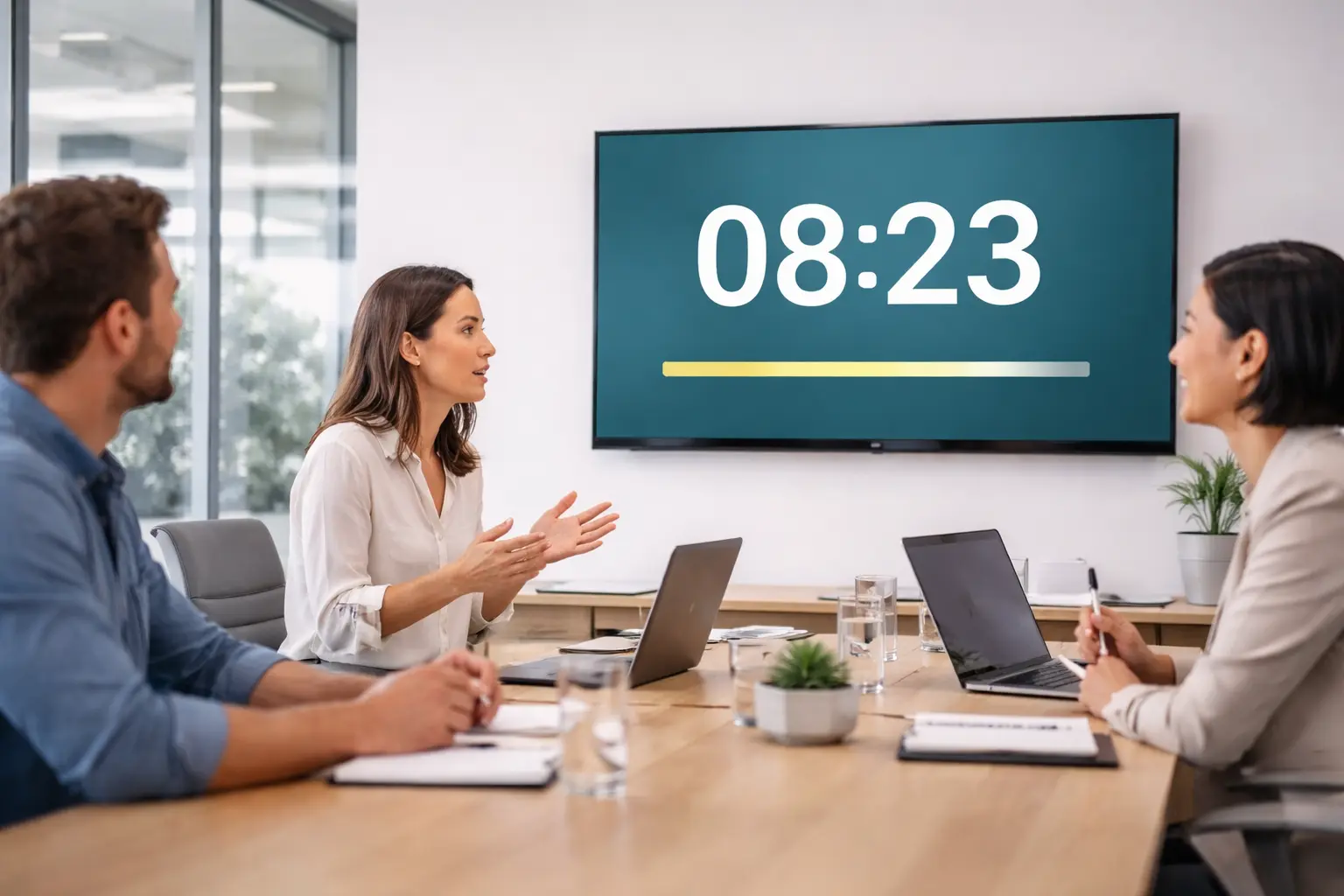
When time remaining is visible to everyone, behavior changes. A shared timer projected on screen or displayed in a video call creates a gentle but persistent reminder that time is finite. It removes the social awkwardness of being the person who points out that the meeting should have ended five minutes ago. The timer does it for you, neutrally and without judgment. You can try a shared meeting timer to see how it transforms the dynamic.
Build in Accountability
Track which meetings consistently overrun and by how much. Share this data with meeting organizers. Most people are not aware of how often their meetings run over because they are not measuring it. When presented with the data, most will take steps to improve. For persistent offenders, escalate the conversation. Meeting discipline is a leadership responsibility, not just a personal preference.
Use a Parking Lot
A parking lot is a list of topics that come up during a meeting but are outside the scope of the current agenda. Instead of diving into these tangents, the facilitator notes them in the parking lot and promises to address them later, either in a follow-up meeting, via email, or in a dedicated session. This keeps the meeting on track without dismissing valid concerns.
Default to Shorter Meetings
Most calendar tools default to 30-minute or 60-minute meetings, but there is no law that says a meeting must fill a standard time block. Try scheduling 25-minute or 50-minute meetings instead. The shorter default creates a natural buffer between meetings and forces organizers to be more disciplined about the agenda. Many teams find that reducing meeting length does not reduce meeting effectiveness because it eliminates the padding and tangents that fill the extra time.
Building a Time-Respectful Culture
Tools and tactics are necessary, but lasting change requires a shift in culture. A time-respectful culture is one where ending a meeting on time is not seen as cutting the conversation short but as a sign of good facilitation. It is a culture where starting a meeting on time is the norm, not the exception. It is a culture where people feel empowered to leave a meeting at its scheduled end time without guilt or judgment.
Leadership Must Model the Behavior
Culture flows from the top. When leaders consistently end their meetings on time, it signals that time discipline matters. When they consistently overrun, it signals the opposite. Leaders who want to build a time-respectful culture should start by auditing their own meeting habits. End every meeting at or before the scheduled time, even if it means tabling a discussion. Apologize when you run over. Thank people for their time. These small gestures set the tone for the entire organization.
Establish Team Agreements
Make meeting discipline explicit. Create team agreements that codify expectations: meetings start on time, they end on time, agendas are shared in advance, and action items are documented. Post these agreements somewhere visible and reference them when the team drifts. Having an explicit agreement makes it easier for anyone to speak up when a meeting is running over, because they are enforcing a shared norm rather than voicing a personal complaint.
Celebrate Improvement
When a meeting that used to run over consistently starts ending on time, acknowledge it. When a team reduces their total meeting hours, recognize the effort. Positive reinforcement is more effective than criticism in building lasting habits. Celebrate the teams and individuals who model good meeting discipline, and make their practices visible to the rest of the organization.